Reading the World
Reading the world requires more than collecting information. Mizan treats reality as an interacting field
of worldview, institutions, social conditions, power centers, instruments of influence, public perception,
outcomes, and feedback.
A Whole-System Map
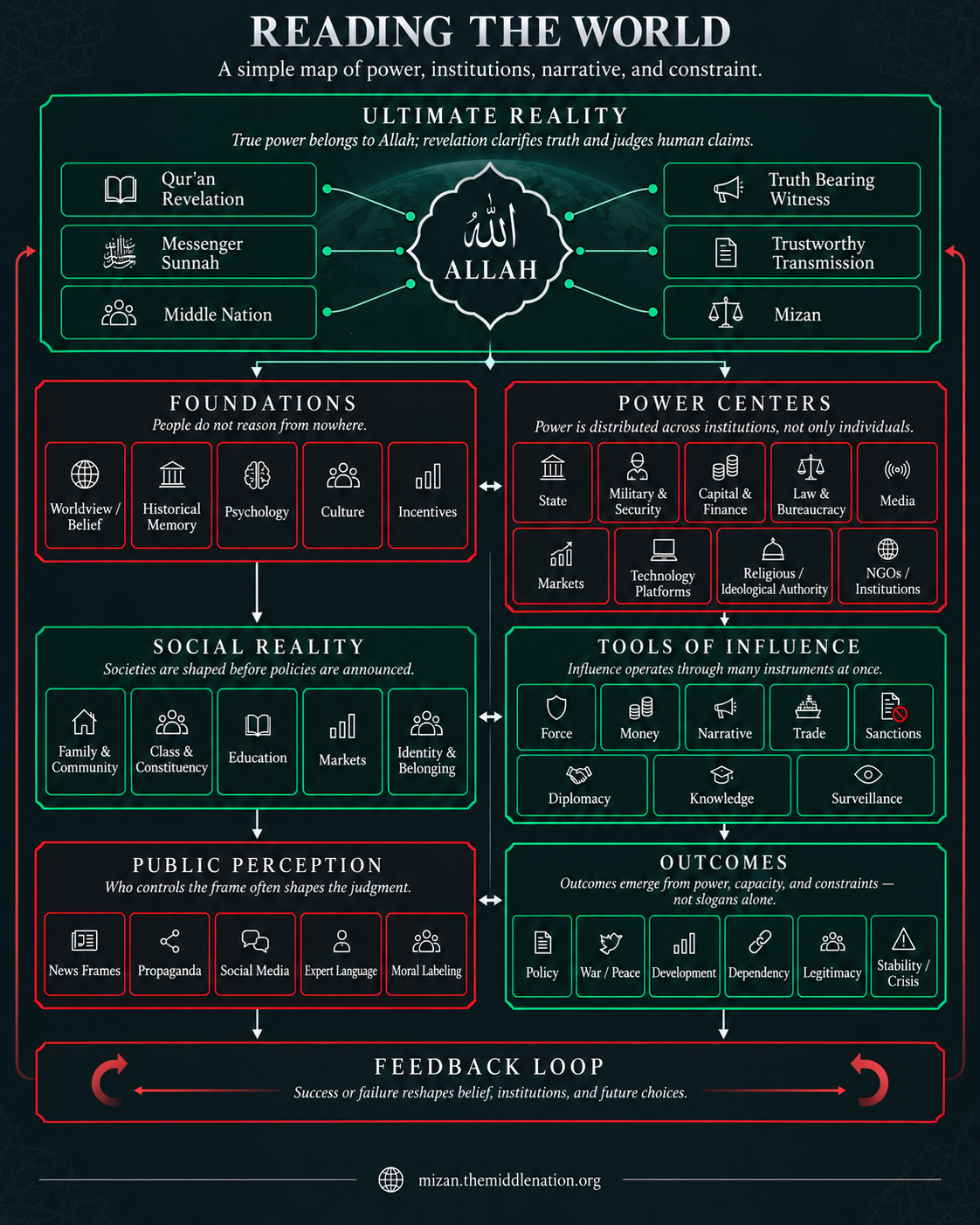
Eight Layers of the Map
These layers provide a stable conceptual spine for future Mizan research, navigation, and analytical
applications. Not every layer yet has a dedicated public publication.
Ultimate Reality
True power belongs to Allah; revelation clarifies truth and judges human claims.
Foundations
Worldview, historical memory, psychology, culture, and incentives shape how reality is interpreted.
Social Reality
Family, constituency, education, markets, class, and belonging shape societies before policy is announced.
Power Centers
Power is distributed across states, security institutions, finance, law, media, technology, and other institutions.
Tools of Influence
Force, money, narrative, trade, sanctions, diplomacy, knowledge, and surveillance operate together.
Public Perception
News frames, propaganda, social media, expert language, and moral labeling shape what people think they are seeing.
Outcomes
Policy, war and peace, development, dependency, legitimacy, stability, and crisis reveal practical consequence.
Feedback Loop
Success and failure reshape belief, institutions, expectations, and future choices.